
Harsh Environments and Qualification of Photonic Integrated Circuit (PIC) Packages
What are harsh environments?
Harsh environments are operating conditions that exceed the limits of standard commercial photonics components and can degrade performance or cause complete device failure. They are commonly encountered in aerospace, defence, industrial, automotive, and space applications, where maintenance is difficult or impossible and reliability is critical.
The primary environmental stressors include:
- Thermal extremes: High and low temperatures, rapid temperature cycling and thermal shock.
- Mechanical stress: High vibration, shock, and acceleration during launch, flight, transportation, or military deployment.
- Moisture and chemical exposure: Humidity, salt fog, corrosive gases, and vacuum environments promote corrosion, contamination, or material degradation.
- Radiation: Ionising radiation and electromagnetic interference can alter semiconductor behaviour or damage the opto-electronics.
Because these conditions exceed the capabilities of conventional photonics, specialised packaging materials, epoxies, manufacturing processes, fibre-to-chip coupling strategies and qualification standards are required.
Challenges for PIC Packages
Photonic Integrated Circuits (PICs) are particularly sensitive to harsh environments because they combine electronic and optical components, whose performance depends on sub-micron-scale alignment. Small mechanical or material changes that have little effect on conventional optics can significantly increase optical loss or reduce device performance in photonics integrated circuits.
One of the main challenges is Coefficient of Thermal Expansion (CTE) mismatch, where materials such as silicon, Indium Phosphide (InP), ceramics, and metal submounts expand at different rates during temperature changes. This can introduce stress, crack solder joints, and misalign optical fibres from the photonic chip. Mechanical shock and vibration further increase the risk of fatigue in wire bonds, die attachments, and optical interfaces.
Moisture ingress can corrode metal interconnects, degrade the performance of the epoxies and degrade optical components by -among other- impacting the quality and lifetime of the semiconductor material for photonic integrated circuits. Vacuum environments introduce the additional challenge of outgassing, where volatile materials contaminate lasers or optical surfaces. In space applications, radiation gradually degrades semiconductor properties – especially the III-V epitaxy-layer– and can also produce transient failures such as laser burnout, additional shot noise in detectors and the electrical performance of the PIC in general.
Impact on PIC Performance
Harsh environments affect both the structural integrity and optical performance of PICs.
Typical failure mechanisms include:
- Degradation of the epitaxial layers in III-V materials and inhabiting electron transport by introducing defects in the semiconductor lattice;
- Fibre-to-chip misalignment caused by thermal expansion;
- Fatigue or cracking of solder joints, wire bonds, and semiconductor dies;
- Corrosion and electrical failures due to moisture ingress;
- Optical contamination from outgassing in vacuum;
- Radiation-induced performance degradation and transient electronic failures;
- Darkening of the oxide layer through high power secondary electron generation.
Since optical coupling tolerances are typically only a few hundred nanometres, even minor dimensional changes can significantly increase insertion loss, shift operating wavelengths, or interrupt optical communication.
Requirements for Space and Defence Applications
PICs intended for space and defence applications require extensive qualification to demonstrate reliable operation throughout their mission lifetime. Qualification focuses on ensuring that the package can withstand the combined effects of thermal, mechanical, chemical, and radiation stresses.
Environmental qualification is commonly performed according to MIL-STD-883, which includes temperature cycling, thermal shock, mechanical shock, vibration, hermeticity, moisture resistance, bond integrity testing and seal integrity testing. Space applications additionally require radiation qualification through Total Ionising Dose (TID) and Single Event Effects (SEE) testing to verify long-term radiation tolerance.
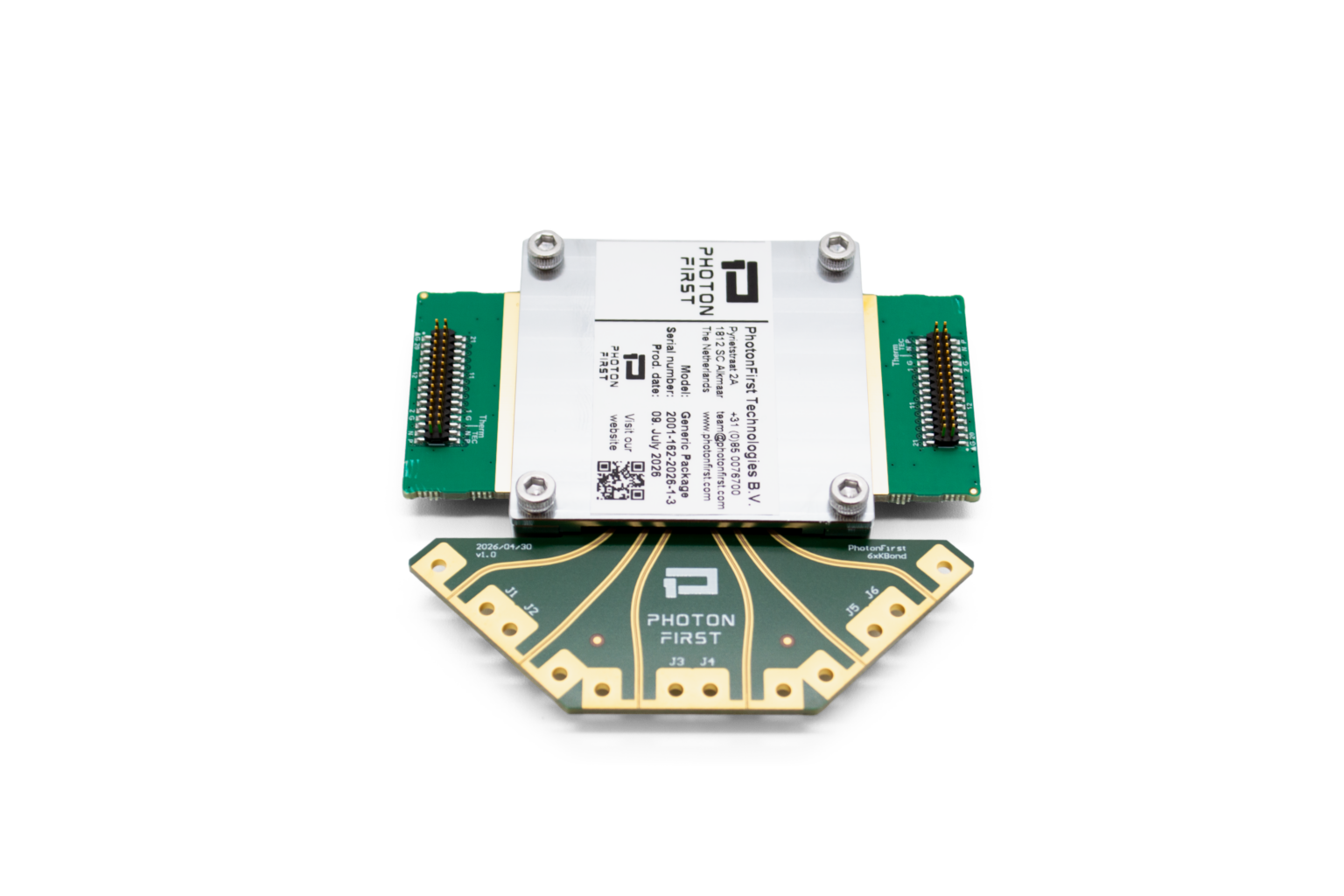
The package itself must also be specifically designed for harsh environments. Typical requirements include hermetic ceramic or metal enclosures, materials with closely matched CTE to minimise thermal stress, low-outgassing materials for vacuum compatibility, and robust die attachment and interconnect technologies.